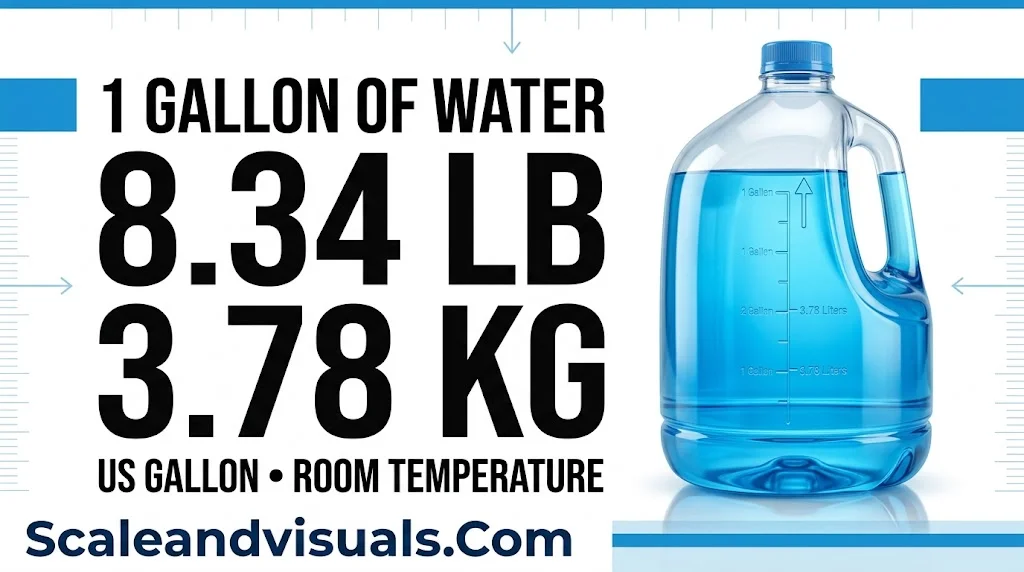
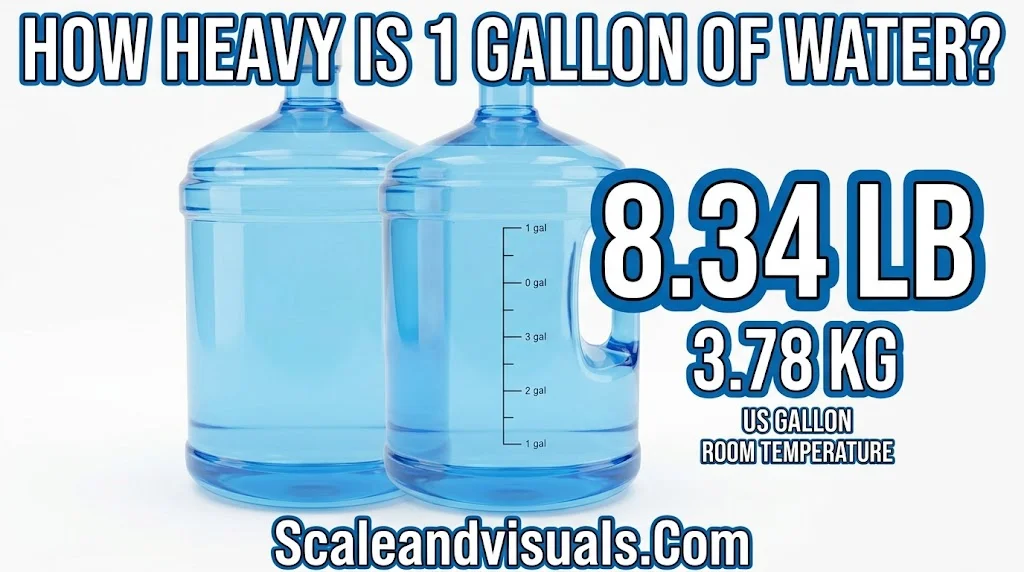
A gallon of water weighs 8.34 pounds (3.78 kilograms) at room temperature. That is the quick answer to how heavy is a gallon of water in the US.
The number shifts a little with heat and dissolved minerals. Below you get the math, a water weight chart, real-life examples and fast answers.
Understanding the weight of everyday items is easier when you can visualize their measurements and compare them with familiar objects. Explore more practical measurement guides and real-life size comparisons with Scale and Visuals to make everyday dimensions easier to understand.
Table of Contents
How Much Does a Gallon of water Weigh in Lbs and Kg?
Here is the exact figure, with the simple math behind it.
One US gallon of liquid weighs about 8.34 lbs (3.78 kg, or 133.5 oz) at room temperature, around 68°F (20°C). One liter weighs 1 kg, or 2.2 lbs. This works because the density of water is close to 1 gram per milliliter, according to the USGS Water Science School.
Here is the math. A US gallon holds 3.785 liters. Multiply that by 1 kg per liter and you get 3.78 kg. Multiply 3.78 kg by 2.2 and you get about 8.34 lbs.
You may also see 8.33 pounds per gallon. Both numbers are fine. The small gap comes from rounding and temperature.
Mass is the amount of matter in an object. Weight is the pull of gravity on that matter. On Earth, people use both words for the same thing.
Watch out for the imperial gallon used in the UK. It holds 4.546 liters and weighs about 10 lbs (4.5 kg). Never swap it for a US gallon when sizing a tank or following a recipe.
Knowing the weight of everyday household items can help you plan storage and manage space more effectively. Similarly, understanding standard door dimensions in the USA can make home improvement projects easier by helping you choose the right door height and fit for your space.
Gallon of Water Weight Chart for Cups, Jugs and Drums
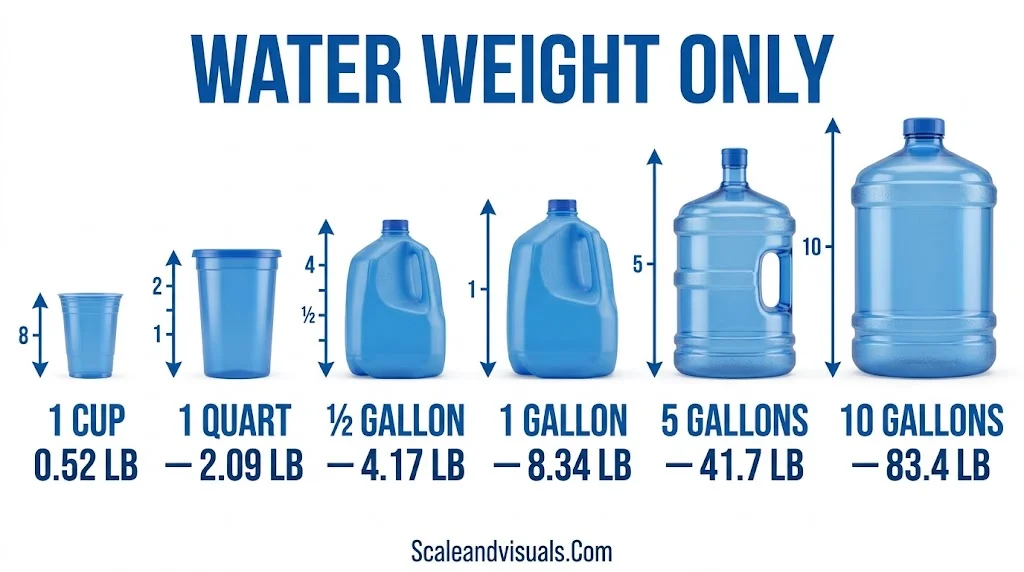
This chart helps you check the weight of a gallon of liquid in pounds and kilograms at a glance. All values assume room temperature.
| Volume | Weight (lbs) | Weight (kg) |
|---|---|---|
| 1 cup (8 fl oz) | 0.52 | 0.24 |
| 1 quart | 2.09 | 0.95 |
| Half gallon | 4.17 | 1.89 |
| 1 gallon | 8.34 | 3.78 |
| 2 gallons | 16.68 | 7.57 |
| 5 gallons | 41.7 | 18.9 |
| 10 gallons | 83.4 | 37.8 |
| 55-gallon drum | 458.7 | 208 |
These numbers cover the water only. The container adds weight. A 5-gallon cooler jug often reaches about 43 lbs with the plastic.
For tanks and pools, use volume units. One cubic foot holds 7.48 gallons and weighs about 62.4 lbs. One cubic meter weighs 1,000 kg, or about 2,205 lbs.
Water is not the heaviest liquid in your home. Here is how other liquids compare per gallon:
| Liquid | Weight per gallon |
|---|---|
| Honey | About 12 lbs |
| Whole milk | About 8.6 lbs |
| Water | 8.34 lbs |
| Olive oil | About 7.6 lbs |
| Gasoline | About 6.1 lbs |
Does Temperature Change How Heavy a Gallon of liquid Is?
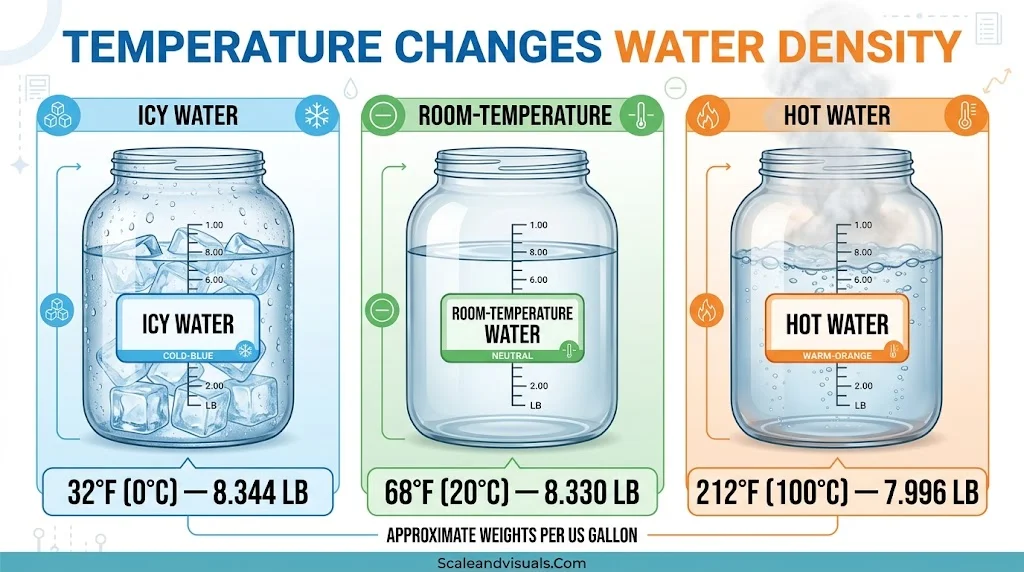
Yes, but only a little. Heat spreads water molecules apart, so the same gallon weighs slightly less.
Water reaches its peak density at 39.2°F (4°C). Above that, thermal expansion takes over. The American Chemical Society explains that heated molecules move faster and take up more space.
| Water temperature | Weight per gallon (lbs) |
|---|---|
| 32°F (0°C) | 8.344 |
| 39.2°F (4°C) | 8.345 |
| 68°F (20°C) | 8.330 |
| 100°F (37.8°C) | 8.280 |
| 150°F (65.6°C) | 8.180 |
| 212°F (100°C) | 7.996 |
Ice-cold water and boiling water differ by about 0.35 lbs per gallon. That is roughly 4 percent. It will not matter in your kitchen. It can matter in lab work or industrial systems.
Dissolved minerals add weight too. The EPA’s secondary guideline for total dissolved solids (TDS) is 500 mg/L. At that level, a gallon gains only about 2 grams. Seawater is heavier, at about 8.5 lbs per gallon.
Does ice weigh more than water? No. Ice has the same mass as the water it came from. It takes up about 9 percent more space, so it is less dense and floats.
For daily math, use 8.34 lbs per gallon. For precise engineering work, use density at the exact temperature.
Why the Weight of a Water Gallon Matters in Real Life
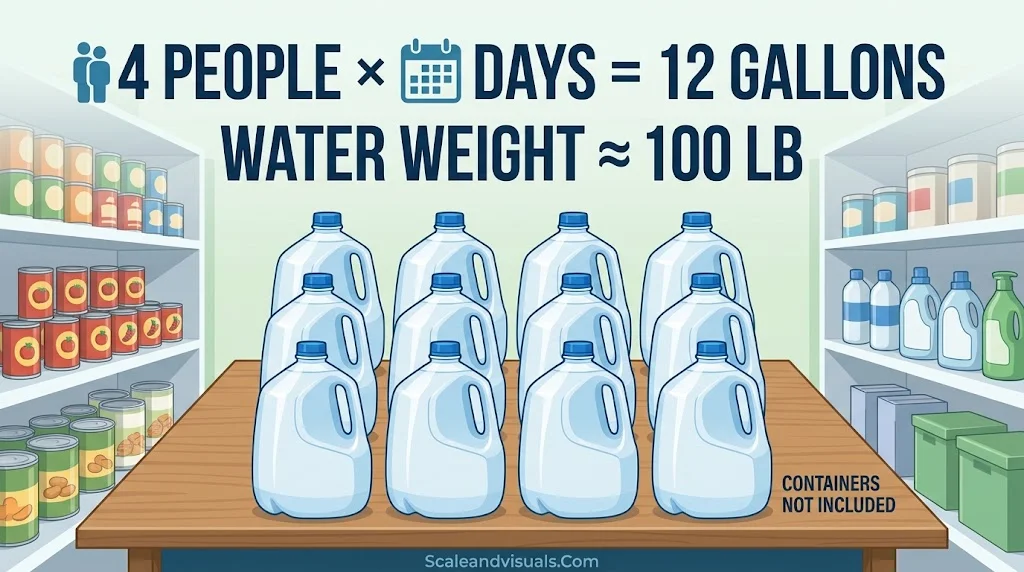
Water weight adds up fast. It affects storage, lifting, travel and even how you size a home filter.
Emergency storage is the clearest example. Ready.gov advises at least 1 gallon of water per person per day. For a family of four over three days, that is 12 gallons, or about 100 lbs before containers.
A few other everyday loads:
- Water heater: A 40-gallon tank holds about 334 lbs of water.
- Hiking: One liter is 2.2 lbs, so three liters add about 6.6 lbs to your pack.
- Lifting: A 5-gallon jug weighs 41.7 lbs. Bend your knees and keep it close to your body.
- Hydration: Drinking eight cups a day means moving about 4.2 lbs of water through your body.
Weight also helps with water treatment. If you plan a reverse osmosis or whole-house filter, knowing your daily gallons helps you size it. A simple TDS test shows what is in your tap water first.
FAQs
Is a gallon of water heavier than a gallon of milk?
No. A water gallon weighs 8.34 lbs. A gallon of whole milk weighs about 8.6 lbs. Milk is roughly 3 percent heavier because it carries fats, proteins and sugars.
How much do 5 gallons of liquid weigh?
Five gallons of liquid weigh about 41.7 lbs (18.9 kg). The jug adds 1 to 2 lbs. A full 5-gallon cooler bottle usually lands near 43 lbs.
How heavy is a 2 gallon jug of water?
A 2 gallon jug holds about 16.68 lbs (7.57 kg) of water. The empty plastic adds a little more. Expect a total near 17 lbs.
How heavy is a gallon of milk?
A gallon of whole milk weighs about 8.6 lbs (3.9 kg). That is slightly more than a water gallon, which weighs 8.34 lbs.
Conclusion
A gallon of water weighs 8.34 lbs (3.78 kg), and that is the number to use for most daily tasks. Adjust only when you need lab-level accuracy or are working with very hot water or seawater. Next time someone asks how heavy a gallon of liquid is, you have the answer.

Abroy Usman is a passionate digital content creator and visual enthusiast dedicated to making complex ideas easier to understand through clear, engaging, and visually appealing content. As an author at Scale & Visuals, he focuses on sharing practical insights, creative ideas, and useful information designed to help readers learn, grow, and make better digital decisions.