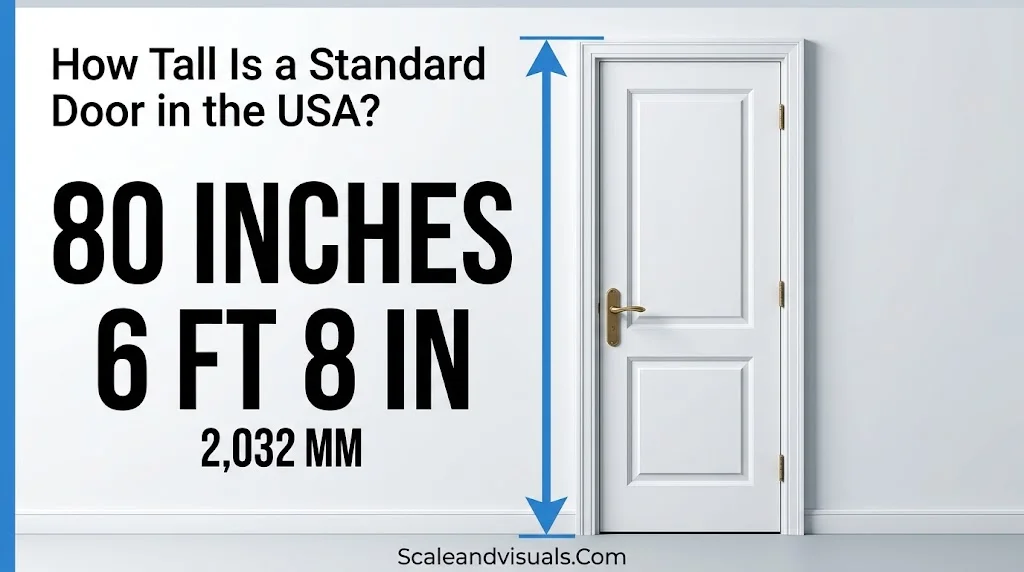
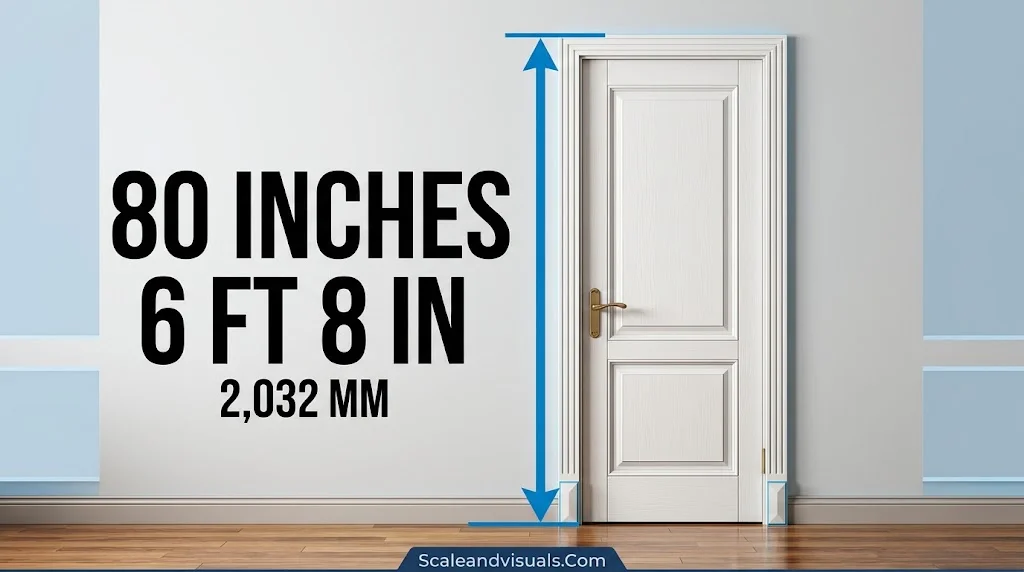
The standard USA door height is 80 inches, or 6 feet 8 inches. That equals 2,032 mm, or about 203 cm. It fits almost every home in the US.
This guide gives you the rule, the exceptions, and the right way to measure. You will also see what building codes say and how American doors compare with UK and metric sizes.
Understanding standard door dimensions is just one part of visualizing everyday measurements accurately. Explore more practical size comparisons and measurement guides to see how common objects, spaces, and dimensions compare in real life with scale and visuals.
Table of Contents
Standard USA Door Height: The 80-Inch Rule

Nearly every US home follows one door height. Here is what it is and why builders chose it.
Understanding standard door height helps you visualize everyday dimensions, but knowing how much space a home offers is equally important when planning a comfortable layout. Explore these real-life 2,000-square-foot home layouts and visual examples to better understand how room sizes and overall living space compare.
What Is the Standard Door Height in the USA?
The standard door height in the USA is 80 inches (6 ft 8 in). This is the standard American door height for most interior doors and exterior doors. Shoppers also call it the 80-inch door or the 6’8″ door.
Why Standard American Door Height Is 6 Feet 8 Inches
Most US homes have 8-foot ceilings, which are 96 inches tall. An 80-inch door leaves 16 inches above it for the header, framing, and trim.
The size also gives most adults plenty of headroom. Factories make one height in huge numbers, so parts stay cheap and easy to find.
Standard USA Door Height for Interior and Exterior Doors
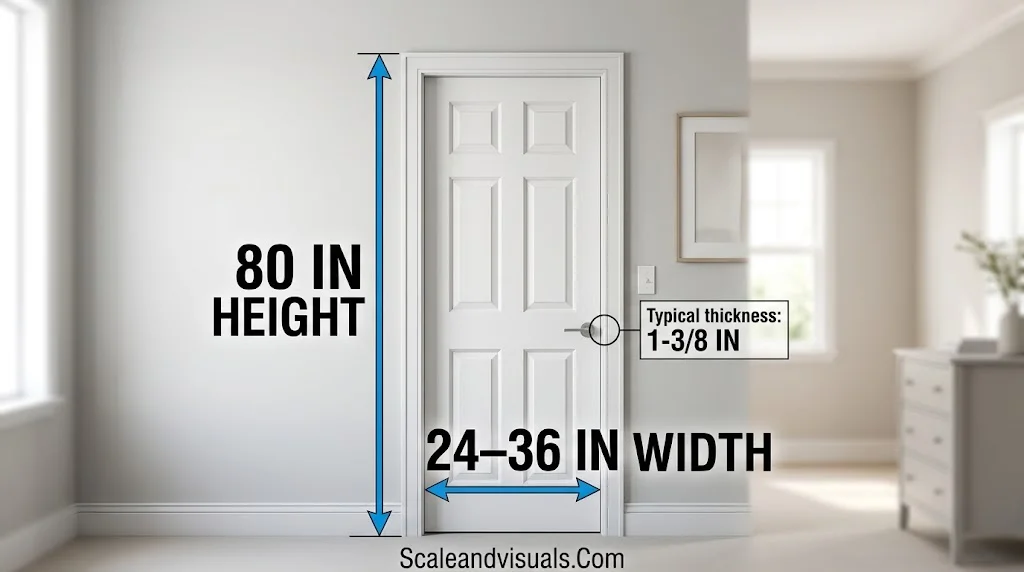
Interior and exterior doors share the same height. Width and thickness are what change.
Standard Interior Door Height in the US
Standard interior door height is 80 inches. Widths run from 24 to 36 inches, and door thickness is usually 1-3/8 inches. Bedrooms often use 30 or 32 inches. Closets use narrower slabs.
Standard Exterior and Front Door Height in the US
A standard front door height is also 80 inches. The most common front door is 36 by 80 inches. Exterior doors are thicker, at 1-3/4 inches, for security and weather resistance.
Standard Door Height by Door Type
The 80-inch rule holds for most door types. Barn doors are the exception.
| Door type | Common height | Common width |
|---|---|---|
| Interior single door | 80 in | 24 to 36 in |
| Front entry door | 80 in | 36 in |
| Side or back door | 80 in | 30 to 32 in |
| French doors (pair) | 80 in | 60 to 72 in total |
| Sliding patio door | 80 in | 60 to 72 in |
| Bi-fold closet door | 80 in | 24 to 72 in |
| Barn door | About 81 in | Opening plus 2 in |
Taller and Shorter Door Heights in US Homes
Not every opening is 80 inches. Ceiling height and home age change the numbers.
84-Inch and 96-Inch Doors for High Ceilings
Newer homes with 9- or 10-foot ceilings often use 7-foot (84-inch) or 8-foot (96-inch) doors. A tall door looks balanced in a tall room. These sizes cost more and ship slower than the standard size.
Why Older Homes Have Shorter Doors
Many older houses have doors near 78 inches (6 ft 6 in). Some basements and attics use 72 to 78 inches. Never assume an old opening is standard. Measure first.
Standard USA Door Height vs UK and Metric Sizes
In England and Wales, the usual door height is 1,981 mm (78 inches). Scotland runs a little taller, near 2,040 mm. A US door is about 2 inches taller than the UK one. A 2-meter door equals 78.7 inches.
How to Measure Standard Door Height and Rough Opening
A wrong number means a returned door. These steps keep your measurements honest.
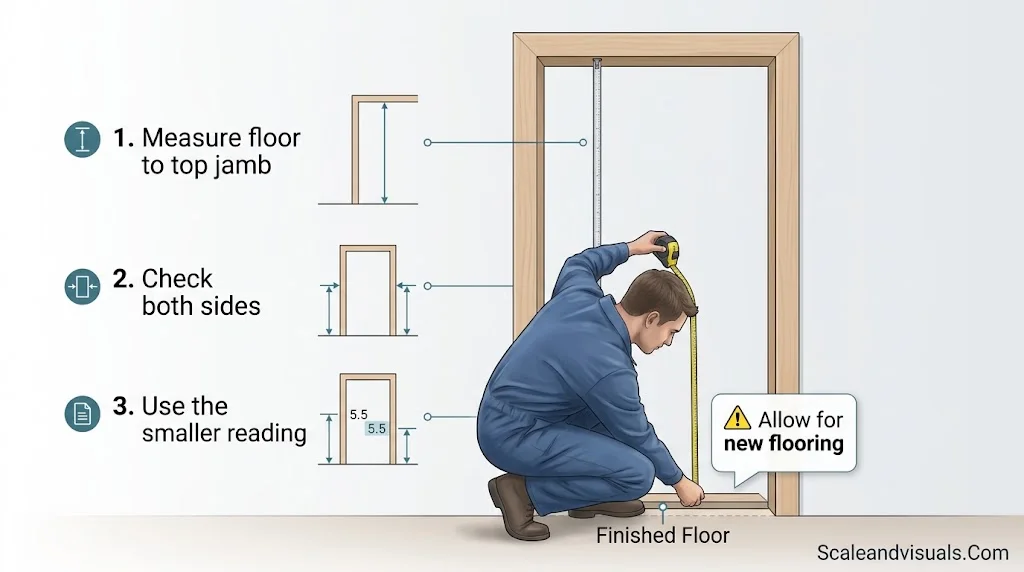
How to Measure Door Height Step by Step
- Measure from the floor to the underside of the top jamb.
- Take the reading on both the left and right sides.
- Use the smaller number.
- Add or subtract for new flooring, since a thick rug or tile can cut clearance.
Do not measure only the old door slab. It may have been trimmed to fit.
Rough Opening Size for a Standard 80-Inch Door
The rough opening is the framed hole in the wall. It should be about 2 inches wider and 2.5 inches taller than the door. A 36 by 80-inch door needs a 38 by 82.5-inch rough opening. This gap leaves room for shims and a level fit.
Door Height Codes and Accessibility Rules in the USA
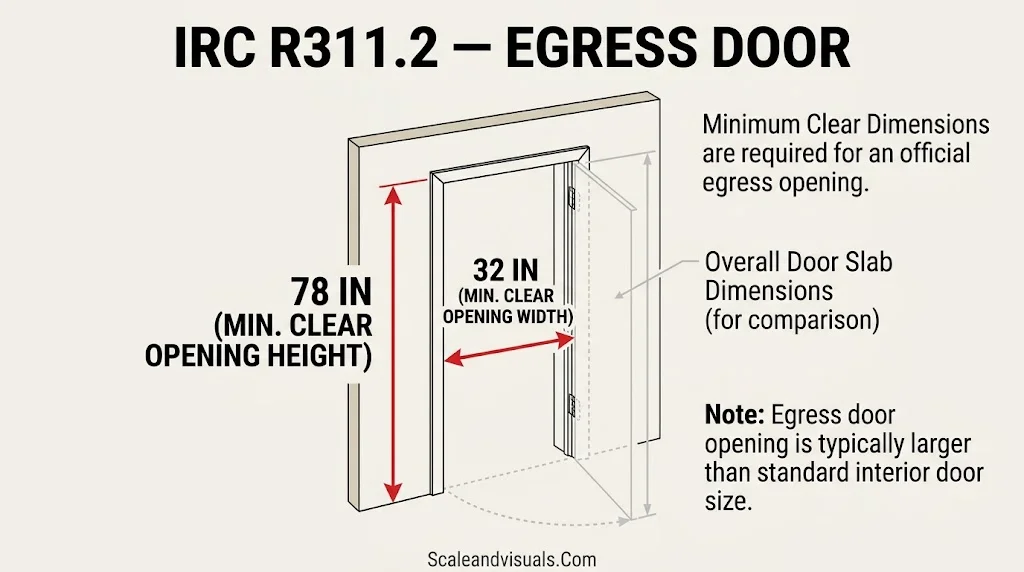
Codes set a minimum, not a standard. That is why code numbers look different from shelf sizes.
IRC Door Height Requirements for Homes
The International Residential Code asks for at least one egress door per home. Section R311.2 says it must be side-hinged. It needs a clear width of 32 inches and a clear height of 78 inches (1,981 mm).
Other doors have no minimum size. Your local building code can be stricter, so check it before you build.
ADA Door Height and Clearance Rules
The ADA Standards call for a 32-inch clear opening width. A 36-inch door is the usual way to get it. ADA rules cover public and commercial buildings. Many homeowners use them as a guide for aging in place.
FAQs
How tall are American doors usually?
American doors are usually 80 inches (6 ft 8 in) tall. Taller 84- and 96-inch doors exist. Some older homes have 78-inch doors.
Is a door 7 feet tall?
A standard door is not 7 feet tall. The usual height is 6 ft 8 in. Doors of 7 feet (84 inches) do exist, mostly in newer homes with 9-foot ceilings.
Is a door 2m tall?
A 2m door is close to standard, but not exact. Two meters equals 78.7 inches, about 1.3 inches shorter than a US door. Metric doors near 2,000 mm are common outside the US.
Can a door be 6 feet tall?
Yes, a door can be 6 feet (72 inches) tall. It is far below the standard, though. It also falls under the 78-inch minimum for a home’s main egress door.
How tall is a regular door in the UK?
A regular UK door is 1,981 mm (6 ft 6 in) tall in England and Wales. Scotland’s standard is a little taller, near 2,040 mm.
Conclsuion
The standard USA door height is 80 inches, and nearly every home is built around it. Measure your opening, check your local code, and the right door will fit the first time.

Abroy Usman is a passionate digital content creator and visual enthusiast dedicated to making complex ideas easier to understand through clear, engaging, and visually appealing content. As an author at Scale & Visuals, he focuses on sharing practical insights, creative ideas, and useful information designed to help readers learn, grow, and make better digital decisions.